- First, read summary on page 185 from your book "Heat Transfer"
-Create an electronic glossary with the following list. (the vocabulary was taken from the reading).
Conduction shape factor
noun
The heat transfer from one surface (at a temperature T1) to the other surface (at T2) can be expressed as: q=Sk(T1-T2) where k is the thermal conductivity of the solid and S is the conduction shape factor.
Example: The shape factor can be related to the thermal resistance: q=Sk(T1-T2)=(T1-T2)/(1/kS)= (T1-T2)/Rt.
es: Factor de forma de conducción
Convection resistance
adjective
Convective Thermal Resistor. Convective Thermal Resistor. where Rconv (SI unit: K/W) is the thermal resistance, which is defined from the surface Area A and the Heat transfer coefficient h as. Model Input. This section has fields and values that are inputs to expressions that define material properties.
es: Resistencia a la convección
Critical radius of insulation
noun
Due to these opposite effects, a critical radius of insulation is defined as the outer radius. that provides maximum rate of heat transfer.
Example: resistance of insulation, but decreases the convection resistance of the surface because of the increase in the. outer surface area.
es: Radio crítico de aislamiento
Cylinder conduction resistance
adjective
Therefore, the heat transfer can be modeled as steady‐state and one‐dimensional, and the temperature of the pipe will
depend only on the radial direction, T = T (r).
Since, there is no heat generation in the layer and thermal conductivity is constant, the
Fourier law becomes:
Example: The surface temperature of the cylinder can be measured with thermocouples, and the resulting cylinder heat flux deduced from Fourier's conduction equation and the unsteady heat conduction equation.
es: Resistencia de conducción del cilindro
Efficiency
noun
In thermodynamics, efficiency is one of the most frequently used terms to indicate how well energy is converted into useful work. Generally it is defined as the ratio of desired output to required input.
Example: In thermodynamics, efficiency is one of the most frequently used terms to indicate how well energy is converted into useful work.
es: Eficiencia
Fin effectiveness
noun
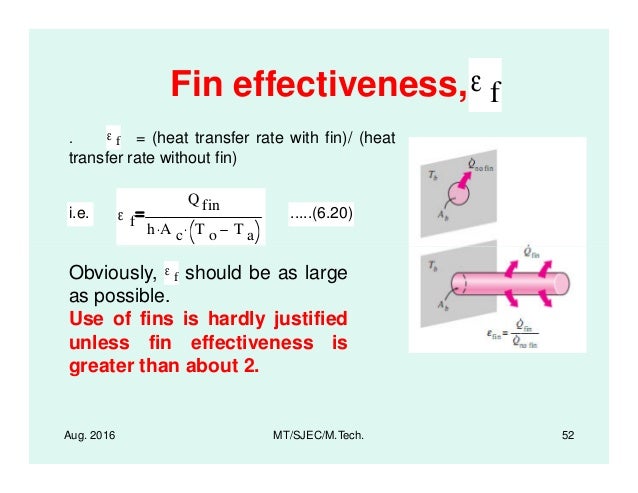
The fin temperature effectiveness or fin efficiency is defined as the ratio of the actual heat transfer rate through the fin base divided by the maximum possible heat transfer rate through the fin base.
Example: The effectiveness of the fin is the dimensionless parameter which can be measured the ratio of
the heat transfer from the fin to the heat transfer occupied by the fin without fin attached.
es: Eficacia de la aleta
Fin efficiency
noun
Fin efficiency is defined as the ratio of actual heat flow of the fin to that which would be obtained with a fin of constant temperature uniformly equal to the base surface temperature.
Example: Fin Efficiency is the ratio of the heat transferred by a fin to the heat that would have been transferred if the total fin surface were at the base (or wall) temperature.
es: Eficiencia de las aletas
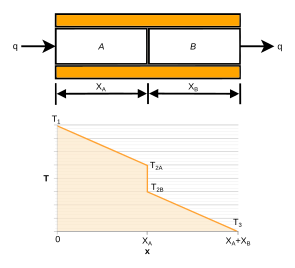
Interface resistance
noun
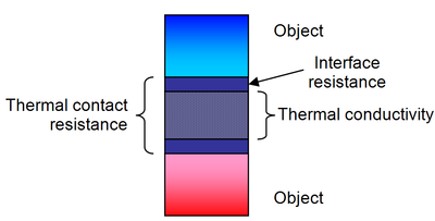
Impairment of heat flow caused by the imperfect contact between two materials at an interface.
Quantitatively, the temperature difference across the interface divided by the heat flux through it.
Example: Interfacial thermal resistance, also known as thermal boundary resistance, or Kapitza resistance, is a measure of an interface's resistance to thermal flow
es: Resistencia de interfaz
Plane wall conduction resistance
adjective
The thermal resistance of a material represents the ability of the material to oppose the flow of temperature.
In the case of homogeneous materials, it is the ratio between the thickness and the thermal conductivity of the material; in inhomogeneous materials resistance is the inverse of thermal conductance.
Example: the resistance to conduction in a flat wall determines the temperature inside the same
es: Resistencia a la conducción de la pared plana
Radiation resistance
noun
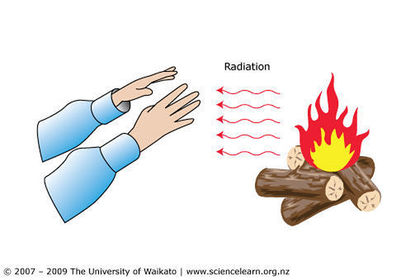
The radiation resistance can be defined as the value of resistance that would dissipate the same amount of power as radiated as radio waves by the antenna with the antenna input current passing through it.
Example: Our results might be useful for the material design of advanced steels for radiation resistance.
es: Resistencia a la radiación
Sphere conduction resistance
noun
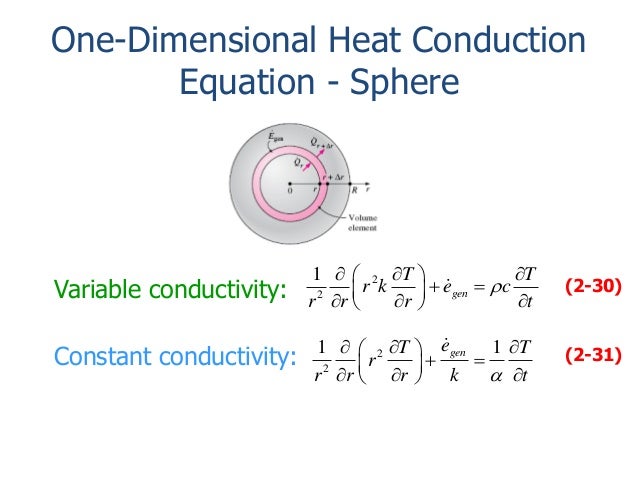
Thermal resistance shows how much the body resists the flow of heat. It is the reciprocal of the thermal conductance, which means that for the sphere we have the different equations to be able to calculate this thermal resistance.
Example: Consider the above diagram to represent an orange, we are interested in determining the rate of heat
transfer through the peel (the peel dimensions are a bit exaggerated!). Heat flow is along radial direction
outwards.
es: Resistencia a la conducción de la esfera
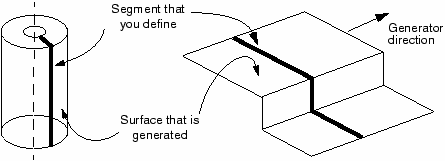
Surfaces
noun
the outside part or uppermost layer of something (often used when describing its texture, form, or extent)
Example: The much smaller downforce generated by the deflectors on the endplates has been modelled in the same manner. The material properties were obtained from the CES Selector materials database. The chosen material being a carbon fibre aluminium composite similar to the material actually used in formula 1.
es: Superficies
Thermal contact conductance
noun
In physics, thermal contact conductance is the study of heat conduction between solid bodies in contact. The thermal contact conductance coefficient, hc, is a property indicating the thermal conductivity, or ability to conduct heat, between two bodies in contact. The inverse of this property is termed thermal contact resistance.
Example: Thermal contact conductance is an important factor in a variety of applications, largely because many physical systems contain a mechanical combination of two materials.
es: Conductancia de contacto térmico
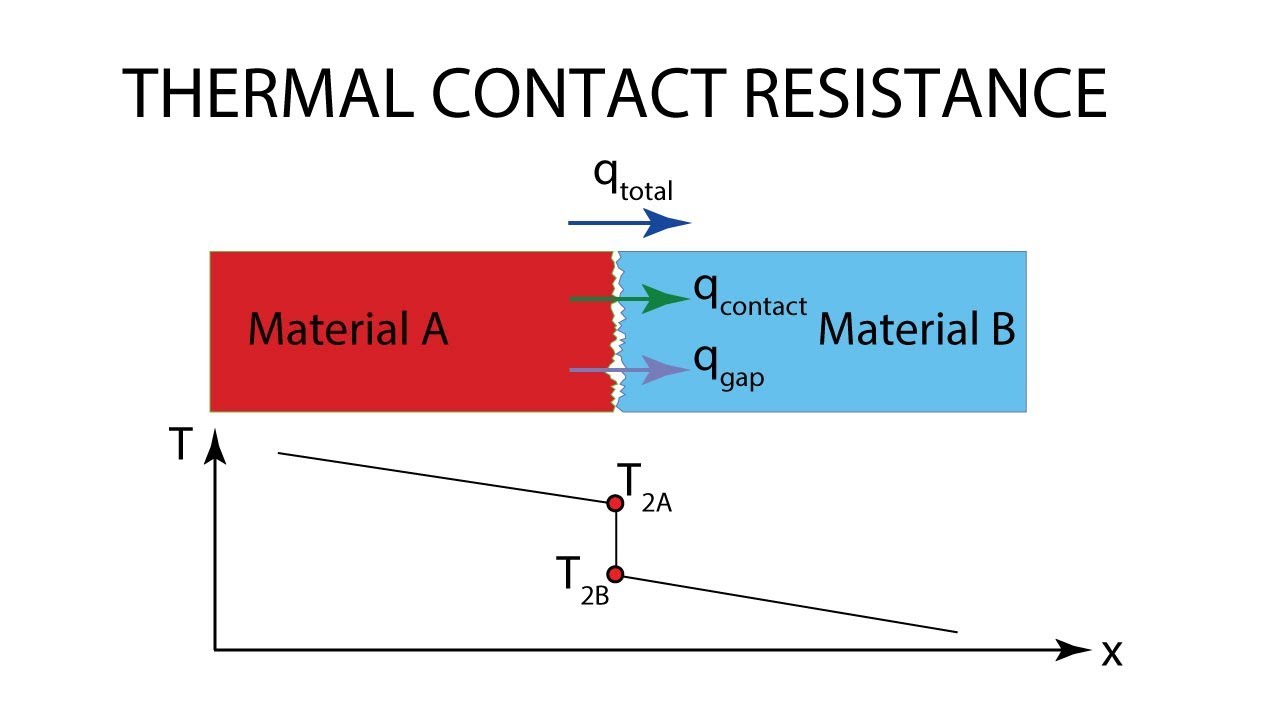
Thermal contact resistance
noun
Thermal contact resistance is defined as the ratio between this temperature drop and the average heat flow across the interface.
Example: When a junction is formed by pressing two similar or dissimilar metallic materials together, only a small fraction of the nominal surface area is actually in contact because of the nonflatness and roughness of the contacting surfaces.
es: Resistencia al contacto térmico
Total thermal resistance
adjective
The thermal resistance of a material represents the ability of the material to oppose the flow of temperature.
Example: Thermal resistance is defined as the ratio of the temperature difference between the two faces of a material to the rate of heat flow per unit area.